
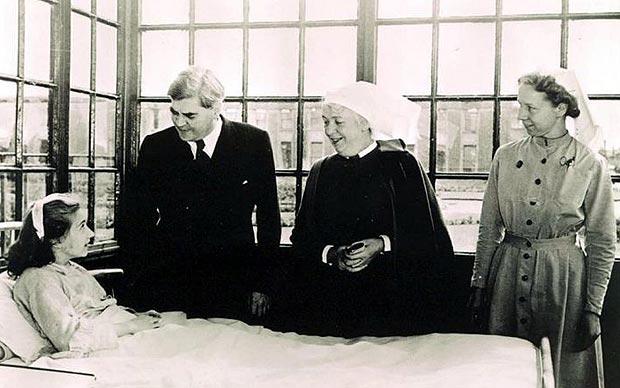
 Two hospitals could be privatised and another will lose its accident and emergency department in the first test of the government’s determination to deal with bankrupt NHS trusts, it has been revealed.
Plans for South London NHS trust were outlined on Monday morning by the special administrator Matthew Kershaw. He said that without action the trust, already losing £1m a week, would accumulate a deficit of more than £240m by the end of 2015. (The Guardian, 29 October)
With the risk of sounding like a moral relativist – even though the self-restraint of dispassionate analysis usually eludes me – all assumptions at the heart of how human society is run are mere conventions – moral, intellectual and often purely accidental. What they are not is universal truths external to human endeavour. They are alive and tacitly accepted for as long as no one successfully challenges them (enter here the 20th century social revolution of your choosing).
So there is nothing self-evident therefore about our requirement to accept a public life permeated by the utilitarian and economistic language and assumptions of the free market system. Its unquestioned aura of scientific authority is our golden cage, comforting us with its promise of trickling prosperity and rigorous efficiency but also locking us into an inescapable logic. A logic of measuring the value of everything primarily and inflexibly in financial terms, with the narrow ideal of pecuniary profit as our only guidance.
This is not a lecture on money being the devil’s eye, as the Eastern European saying goes. It’s an expression of concern that the only thing that remains where social purpose used to exist is the unforgiving orthodoxy of neo-liberal capitalism.
“Bankrupt” NHS trusts, hospitals “losing” money, profit-driven private sector service providers beckoned to impart their wisdom on efficient delivery… This language has no place in the healthcare system, because it represents a set of values that belong to the world of business transactions. The NHS has one sole purpose, of an entirely moral nature: that of keeping us all alive and well, irrespectively of who we are.
I agree that this is a moral convention, not an immovable truth. Therefore, when it is being challenged, we need to acknowledge it overtly, so that we can soberly explore whatever new moral conventions are being put in its place.
I have just re-read Nye Bevan’s “In Place of Fear” (Heinemann, 1952) after many years, wanting to better understand the moral order that produced the NHS and public service as we know it today. As an aside, it’s remarkable how little ground we’ve covered in public debate over 60 years – we are slaves to the same political dichotomy, but we have, rather tragically, given up on arguing morally about our social purpose.
You may like to contrast and compare with the Guardian quote above, bearing in mind your own ideas about the purpose of society:
“The field in which the claims of individual commercialism come into most immediate conflict with reputable notions of social value is that of health.” (Pg. 73)
“[Contagious diseases] are kept at bay by the constant war society is waging in the form of collective action conducted by men and women who are paid fixed salaries. Neither payment by result nor the profit motive are relevant.” (Pg. 74)
“They do not flow from [competitive society]. They have come in spite of it. They stem from a different order of values. They have established themselves and they are still winning their way by hard struggle. In claiming them, capitalism proudly displays battles it has lost.” (Pg. 74)
“The collective principle asserts that the resources of medical skill and the apparatus of healing shall be placed at the disposal of the patient, without charge, when he or she needs them; that medical treatment and care should be a communal responsibility, that they should be made available to rich or poor alike in accordance with medical need and by no other criteria.” (Pg. 75)
“The National Health Service and the Welfare State have come to be used as interchangeable terms, and in the mouths of some people as terms of reproach. Why this is so it is not difficult to understand, if you view everything from the angle of a strictly individualistic Competitive Society.” (Pg. 81)
“[The NHS] is therefore an act of collective goodwill and public enterprise and not a commodity privately bought and sold.” (Pg. 82)
“A free Health Services is a triumphant example of the superiority of collective action and public initiative applied to a segment of society where commercial principles are seen at their worst.” (Pg. 85)
I am not quoting from Bevan for the purposes of argumentation in public debate. His aura and legacy may inspire, but do not serve as evidence. We do not owe the architects of our public services unwavering loyalty to their ideas. I am using his words to highlight the worldview that produced the services and guarantees we now take for granted. For we must put something in its place if we decide to bring it down.
There is nothing self-evident about requiring the NHS to be profitable or about assuming that private service delivery will bring with it increased efficiency. Both of these assumptions stem from a worldview incompatible with that which conceived the NHS. The latter is doomed to fail even against the criteria of its own neo-liberal value system:
“… the worst sort of ‘mixed economy’: individual enterprise indefinitely underwritten by public funds. In Britain, newly privatised National Health Service Hospital Groups periodically fail – typically because they are encouraged to make all manner of profits but forbidden to charge what they think the Market might bear.
[…] The result is moral hazard” (Tony Judt, Ill Fares the Land, Pg. 111-112)
But that’s a different debate altogether.




 Amplified