Self-evident truths

Two hospitals could be privatised and another will lose its accident and emergency department in the first test of the government’s determination to deal with bankrupt NHS trusts, it has been revealed.

Plans for South London NHS trust were outlined on Monday morning by the special administrator Matthew Kershaw. He said that without action the trust, already losing £1m a week, would accumulate a deficit of more than £240m by the end of 2015. (The Guardian, 29 October)

With the risk of sounding like a moral relativist – even though the self-restraint of dispassionate analysis usually eludes me – all assumptions at the heart of how human society is run are mere conventions – moral, intellectual and often purely accidental. What they are not is universal truths external to human endeavour. They are alive and tacitly accepted for as long as no one successfully challenges them (enter here the 20th century social revolution of your choosing).

So there is nothing self-evident therefore about our requirement to accept a public life permeated by the utilitarian and economistic language and assumptions of the free market system. Its unquestioned aura of scientific authority is our golden cage, comforting us with its promise of trickling prosperity and rigorous efficiency but also locking us into an inescapable logic. A logic of measuring the value of everything primarily and inflexibly in financial terms, with the narrow ideal of pecuniary profit as our only guidance.

This is not a lecture on money being the devil’s eye, as the Eastern European saying goes. It’s an expression of concern that the only thing that remains where social purpose used to exist is the unforgiving orthodoxy of neo-liberal capitalism.

“Bankrupt” NHS trusts, hospitals “losing” money, profit-driven private sector service providers beckoned to impart their wisdom on efficient delivery… This language has no place in the healthcare system, because it represents a set of values that belong to the world of business transactions. The NHS has one sole purpose, of an entirely moral nature: that of keeping us all alive and well, irrespectively of who we are.

I agree that this is a moral convention, not an immovable truth. Therefore, when it is being challenged, we need to acknowledge it overtly, so that we can soberly explore whatever new moral conventions are being put in its place.

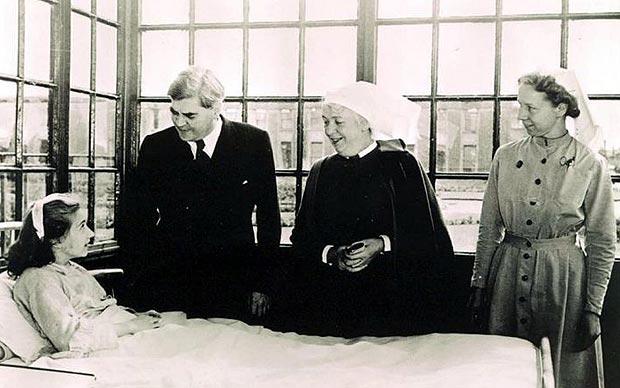
I have just re-read Nye Bevan’s “In Place of Fear” (Heinemann, 1952) after many years, wanting to better understand the moral order that produced the NHS and public service as we know it today. As an aside, it’s remarkable how little ground we’ve covered in public debate over 60 years – we are slaves to the same political dichotomy, but we have, rather tragically, given up on arguing morally about our social purpose.

You may like to contrast and compare with the Guardian quote above, bearing in mind your own ideas about the purpose of society:

“The field in which the claims of individual commercialism come into most immediate conflict with reputable notions of social value is that of health.” (Pg. 73)

“[Contagious diseases] are kept at bay by the constant war society is waging in the form of collective action conducted by men and women who are paid fixed salaries. Neither payment by result nor the profit motive are relevant.” (Pg. 74)

“They do not flow from [competitive society]. They have come in spite of it. They stem from a different order of values. They have established themselves and they are still winning their way by hard struggle. In claiming them, capitalism proudly displays battles it has lost.” (Pg. 74)

“The collective principle asserts that the resources of medical skill and the apparatus of healing shall be placed at the disposal of the patient, without charge, when he or she needs them; that medical treatment and care should be a communal responsibility, that they should be made available to rich or poor alike in accordance with medical need and by no other criteria.” (Pg. 75)

“The National Health Service and the Welfare State have come to be used as interchangeable terms, and in the mouths of some people as terms of reproach. Why this is so it is not difficult to understand, if you view everything from the angle of a strictly individualistic Competitive Society.” (Pg. 81)

“[The NHS] is therefore an act of collective goodwill and public enterprise and not a commodity privately bought and sold.” (Pg. 82)

“A free Health Services is a triumphant example of the superiority of collective action and public initiative applied to a segment of society where commercial principles are seen at their worst.” (Pg. 85)

I am not quoting from Bevan for the purposes of argumentation in public debate. His aura and legacy may inspire, but do not serve as evidence. We do not owe the architects of our public services unwavering loyalty to their ideas. I am using his words to highlight the worldview that produced the services and guarantees we now take for granted. For we must put something in its place if we decide to bring it down.

There is nothing self-evident about requiring the NHS to be profitable or about assuming that private service delivery will bring with it increased efficiency. Both of these assumptions stem from a worldview incompatible with that which conceived the NHS. The latter is doomed to fail even against the criteria of its own neo-liberal value system:

“… the worst sort of ‘mixed economy’: individual enterprise indefinitely underwritten by public funds. In Britain, newly privatised National Health Service Hospital Groups periodically fail – typically because they are encouraged to make all manner of profits but forbidden to charge what they think the Market might bear.

[…] The result is moral hazard” (Tony Judt, Ill Fares the Land, Pg. 111-112)

But that’s a different debate altogether.

The way we talk

We must question the narratives that shape our public space if we are to have any certainty in the body of policies that guide us.

A political battle is won when your opponents adopt your framing of an issue in their own arguments. The way we talk about social problems, their sources and their dangers shapes our amenability to specific policy remedies. It primes us to accept a particular worldview as accurate, along with the social problems it identifies and the course of action it proposes. I have talked about this many times already. It is a key issue at the heart of what Amplified seeks to do and obvious though it may sound, it’s usually ignored – particularly in an age in which political debate is underpinned by a tacit consensus on the usefulness of neo-liberal economics.

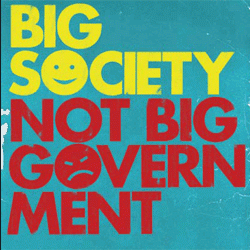
Public debate is swamped with denials of the social causes of deprivation and disadvantage. Perversely, there is no such thing as society in the Big Society. The individual alone is the subject of praise and recrimination, the recipient of reward, incentive and admonishment. Individual responsibility and merit alone explain success and failure; they also justify coercion and recompense. Inequality of opportunity has all but vanished from the public space. All that remains is individual choice.

The worthy wealth creators and hardworking homeowners sit in one camp while the destitute, the invalid and the jobless are shown the error of their ways. If society plays no part in their predicament, the wicked must be shown the virtuous path through penitence. The law is no longer there for the vulnerable, but for the upright citizens and the paragons of success – for their economic and social advantages are a reflection of their own merit. No example is better than the abolishment of the so-called “squatters’ rights” to offer further protection than what already existed for hardworking homeowners. This riles me despite my own experience as a homeowner whose house was quite literally devastated by an unwelcome guest. The law should favour the needy, the vulnerable and the disadvantaged. It’s the very least it can do.

I write about the stories we tell in our public space because they are the mechanism via which ideology becomes indistinguishable from common sense. I make no secret of my own ideological bias in my writing – indeed, it would be very hard to. I truly fear that by denying the social causes of deprivation and disadvantage, we also remove our obligation to care, our very capacity for compassion, and ultimately the precious bonds that hold us together as a community with a social purpose.

The way we talk shapes the way we think and, in turn, the way we act. When ideology becomes common sense, there is little room left for manoeuvre and debate. That is why the right questions need to be asked at the right time. We must question the narratives that shape our public space if we are to have any certainty in the body of policies that guide us.

Quangos on the bonfire

The government’s dismantling of 100 quangos has been the subject of some astoundingly superficial news coverage over the past couple of days. One unchallenged narrative reigns supreme, allowing of course for varying degrees of passion (the Telegraph are demanding a quango cull here  – a bit harsh, chaps?). “The bonfire of the quangos” is a widely used expression in the commentary that does exist, usually without irony (or horror).

This narrative is, as always, a story of decline and control, with quangos as culprits and the government as the agents redressing the balance. It goes a little like this: quangos squander public funds >> the government throws quangos on the bonfire >> working families save £100 each. Hands up, who doesn’t like £100?

It’s worth taking a minute to unravel the assumptions at the heart of this story and revel in its rich metaphoric load. The word “quango” is derogatory by definition (see OED here) and most likely not how the agencies being dismantled would describe themselves. It seems to go without saying that a quango is some sort of bureaucratic excrescence with little use or accountability. This may well be the case for some of the organisations in question. We just don’t know. And that is the problem.

The implication is clear that a true provider of meaningful public service would simply not be labelled a quango. Or would it? That is a key question that isn’t being addressed in political debate or in any of the media coverage and commentary. Are our needs sufficiently clearly defined as a society for us to decide which public services are superfluous? Do we possess a broadly endorsed methodology for measuring the value of public service and thus decide which organisations fall below the minimum benchmark? Should an efficiency saving be anything more than obtaining the same amount of value from a smaller investment? Does losing a useful service constitute a saving? How can any of these questions be answered in the absence of the debate that we are not having?

As for the brutal imagery of bonfires and culling, well, I find it all a little chilling. How could the National Film Council and the National Endowment for Science, Technology and the Arts – for they are among the quangos being zapped – possibly inspire such savage passions? Is this a modern day bonfire of the vanities? Are quangos the Guy Fawkeses of this recession?

This sort of loaded and highly normative language is changing our world for generations to come. What we are dealing with here reaches far beyond a bunch of public bodies being dismantled. A new philosophy of public service and the role of the state is taking shape. This is not necessarily bad, nor dangerous – unless, of course, it happens a little too “organically”, without broad debate on social goals and without appropriate consent. We need to be asking the right questions.

Political reality is a social creation of our own making. It’s an extraordinary edifice of belief, language and subjective perception to which new facts and information serve little extra purpose than to reinforce views and attitudes already held. There is a significant body of psychological and sociological research that suggests human beings do not on the whole make a lot of use of the cold analytical skills that rational choice theory credits us with. Sometimes I think it wouldn’t be a bad thing if we did.

There is no alternative

No words are more abused in politics than these. I touched on it already in my previous article here. I will keep highlighting this sort of language and its implications. Because everything in public life is constructed – through stories and language and imagined enemies and belief – and there is always at least one other way. The way that involves not taking the course of action presented as the only way.

Professor Terence Stephenson, chair of the Academy of Medical Royal Colleges (AoMRC), wants ministers and NHS bosses to downgrade some hospitals and push through major rationalisation of key services such as major surgery or intensive care, despite local campaigns to save units. He says this is the only way – yes, apparently there is no other way – to improve healthcare for the most seriously ill. He says too many hospitals provide the same services only miles between one another. There must be rationalisation. There must be cutbacks and hospital closures.

The same services. Yes. Of course they provide the same services. They provide healthcare. They are not department stores competing for market share. They are hospitals, keeping us alive and well in our hour of need. Healthcare provision must surely be one of the core goals of living together in organised society. Yet we are told that having less healthcare available will make everything better for us overall. As if nothing could possibly be changed about the way the NHS is run and funded apart from the volume of service provided.

For me as a citizen, universal healthcare provision is a moral question. Yes, it’s a collective financial burden. But it’s the price we must pay for civilisation. Yes, we live longer and treatments are increasingly complex and expensive. But if it needs funding, we must fund it. Some say that’s naïve. Yet we live in a world in which trillions of dollars are tucked away by the wealthy in offshore tax havens while governments claim that proportional taxation only increases tax avoidance. I am not sure what is more naïve.

The reason I keep writing about language is because it’s fundamentally normative. The pictures that are painted for us have a pre-defined course of action inscribed in them. They are not neutral, nor are they there (solely) to share useful facts. The chairman of a professional medical association speaks with a certain degree of authority. Yet he paints a rather skewed picture.

I will accept that healthcare provision must be reduced if it’s a collective and informed choice. I won’t see it as our only choice, but it will be our choice nonetheless. What I struggle to accept is that we can only afford a downgraded form of civilised society and that there is no alternative.

One of my local hospitals is going to lose its A&E department as part of this rationalisation drive. I guess you can have too much emergency care.

Four legs good

The time has come for policy-making to be based on evidence rather than belief.

Recent stories about the corruption and incompetence of private sector contractors delivering public services raise important questions about key assumptions at the heart of political debate. For those who haven’t read enough about it already, I recommend Private Eye’s excellent series of investigations into companies delivering the DWP’s contested workfare programme. Polly Toynbee also asks some valid questions in the Guardian here.

I cannot help but view these stories in their broader context, against a backdrop of systemic change in the philosophy of public service delivery, i.e. the idea of opening up all delivery to any able provider. Here’s how the Cabinet Office’s March 2012 Open Service review frames the current debate:

“This means replacing top-down monopolies with open networks in which diverse and innovative providers compete to provide the best and most efficient services for the public. It means re-thinking the role of government – so that governments at all levels become increasingly funders, regulators and commissioners, whose task it is to secure quality and guarantee fair access for all, instead of attempting to run the public services from a desk in Whitehall, city hall or county hall.”

As always, the use of language tells us a lot about underlying ideological assumptions. What we have here is a typical story of decline (public services not up to scratch), with a cause and a perpetrator (out-of-touch central or local administration sucking the life out of public services from their bureaucratic towers) as well as an agent capable of taking the reins and reversing the decline (the diverse and innovative providers).

story of decline >> cause selection >> agent >> control

This simple narrative structure (story of decline >> cause selection >> agent >> control) underpins pretty much all political activity. It’s incredibly useful, as it creates a remit for action, with the promoters of the narrative as the agents. Its imagery juxtaposes vibrant (private) service providers to grey out-of-touch (public) bureaucrats – needless to say that in our collective imagination, vibrant and colourful beats stale and grey quite effortlessly.

This is an old mantra – the idea that the private sector is by its very nature an innovative and efficient service provider, as opposed to the state, which isn’t. Four legs good, two legs bad, in other words. Political language reinforces this mantra though stories of decline and control such as the one above. It has become so established that it’s taken as a given, in political as well as public debate.

But scandals such as G4S, A4E and Working Links show that analysis and reflection have not yet become redundant. The time has come for policy-making to be evidence rather than belief-based. I am fully aware of my own outsourcing-sceptic bias when I say this. What this debate needs is a body of research looking at quality of service and public accountability and inquiring whether the private sector, with its profit imperatives and commercial focus, is indeed inherently and demonstrably better endowed to deliver high-quality public goods and services. Then and only then will public policy be informed by evidence, as opposed to belief, ideology and other superstitions – my own included.

When that happens, we can all accept, as the case may be, the self-evidently superior nature of the delivery of public services by the private sector as the only available option and only feasible way, as the Open Service review would have us believe.

“Given the fiscal constraints, the only feasible way of making the gains in quality of service that our economy and society so urgently need is to make a step change in the productivity of the public services. And the only feasible way of achieving such a step change in public service productivity is to introduce competition, choice and accountability – so that the public services can display the same innovation and entrepreneurial drive that characterise the best of the UK’s economy and society.”

Until then, I will keep wondering.

Individual merit

As a political communicator, I cannot help but find language a rich resource of insight into the preconceptions and moral priorities that underpin public policy. One of the most interesting aspects of Big Society discourse, for example, is its seamless combination of communitarian “let’s do it”, “we’re all in this together” language with individualist ideas of responsibility, merit and a reward/punishment moral accounting system. Of course, all language hides a moral system, with ideological elements that are accepted as common sense. And naturally, there is no such thing as common sense, or rather, there is nothing common about it. Our ideas of what constitutes common sense are very much tied in with the moral and ideological conventions we subscribe to.

Take poverty and inequality for example. They are universally deplored as unacceptable and in Big Society discourse their eradication is as much a priority as in leftwing traditions. Poverty is a moral issue, an immoral state of affairs or a moral failure – in that it is morally unacceptable for deprivation to exist in our broadly shared ideas about society. That may sound nurturing and communitarian, but a closer look reveals a different story. Welfare in Big Society discourse is a trap (this is actually a commonly used metaphor) and welfare dependency very much an individual issue. That is, a failure of the individual as opposed to a systemic deficiency. Here’s how deprivation is explained in the DWP’s Social Justice blueprint from March 2012:

« Though low income is a useful proxy measure, it does not tell the full story of an individual’s well-being. Frequently, very low income is a symptom of deeper problems, whether that is family breakdown, educational failure, welfare dependency, debt, drug dependency, or some other relevant factor.»

This is a story of individuals erring from the moral path of small-c conservative righteousness, which would stipulate strongly fused family units, educational accomplishment, economic self-reliance, thrift and a healthy and wholesome lifestyle. Therefore it follows that economic deprivation is a symptom of individual moral failure, as opposed to being an effect of societal inequality of opportunity.

Why does this matter? It matters because the moral assumptions underpinning the DWP’s current outlook may well end up monopolising the welfare debate, as they are pretty much unchallenged in mainstream political debate, at the level of narratives. Which means the idea of individual merit is likely to become a prevalent explanation of economic success and deprivation. And this will affect the way we look at poverty and the amount of sympathy we are willing to allocate to it for generations to come. We may one day not so long from now be talking about the “undeserving poor”. I can accept this, although it goes against my own ideological bias, as long as we are aware of it happening, and conscious of the moral choice we are making – for it is a moral choice, as opposed to something self-evident, belonging to the realm of common sense. This is why peeling the layers of the language of politics is a satisfying and worthwhile pastime.