A cold wind from the east

eastern invasionI live in a country that I have known and loved for more than half of my life. I feel part of its living, breathing fabric and it’s an indelible part of who I am. Building on my vestigial instincts, England is what made me the bleeding-heart, doubting, tormented cosmopolitan I feel that I am meant to be. Slowly but surely, it rubbed away most signs of who I was before I knew it. I belong here, it is my home.

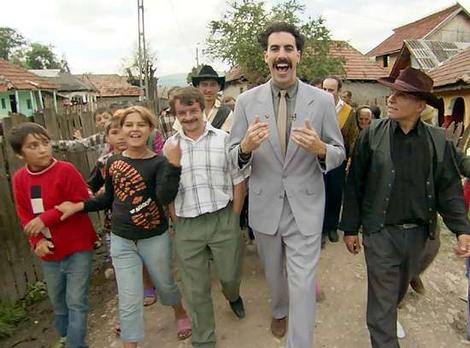
Lately, our government has been working hard to raise alert about the impending invasion of my countrymen, rebranded bogeymen. Romania and Bulgaria’s seven-year “transitionary” restrictions to the EU labour market are coming to an end, which in theory should make all EU citizens equal. We are told they are poised to invade these fragile shores and pilfer our lowest-status jobs, seduce our women, and push in front of us in the queue at Sainsbury’s. Or something like that. We don’t know how many will turn up and what untold chaos they will wreak, but we await them nervously. The appalling barbarians must be dissuaded from believing they will have a fun time in these parts, so we are making TV adverts assuring them they won’t. In their grotesque lack of sophistication, they will think twice about moving to a country where it rains a lot and where they won’t find a ‘welcome’ dole office at the border so that they can take advantage the second they arrive.

Inconvenient truths must be cast aside to protect the nation – such as that migrants have been shown to be substantially less inclined to claim benefits than their bona fide British brothers and sisters.

I for one didn’t turn up on these shores for the weather nor for the legendary 60 pounds per week of Jobseekers’ Allowance. I wasn’t terribly interested in reaping the benefits of Western neoliberal capitalism either. I came to the UK because I felt at home among its self-deprecating, open-minded and reflective people. In time, I grew accustomed to unyielding gravity-fed hot water systems, mint sauce and harassment at the border control desk. It was a price I could happily pay to live in a society of like-minded folk. I am now told I was miss-seeing things. England didn’t mean it. We are not all born equal. My presence is worrisome. England had rather I stopped playing with its toys.

The incensed are right to a large degree. Their innate sense of fairness is quite rightly ringing alarm bells. Some people out there are indeed taking advantage. They are stoking up our basest fearful instincts, hopeful that we might overlook the real abuses they themselves are carrying out. Frothing with rage at the thought of – largely imaginary – outsiders benefiting unduly from a society they do not contribute to, we close our eyes to those robbing us blind from their privileged positions near the centre of power. It is the dismantling of the public service system and its selling off to a variety of friendly bidders that should make us angry, and the demonization of the state in its protective – but never its coercive – capacity. It’s the dissolution of our employment and social security rights that should incense us. These are the things making life much worse for us and those who will come after us. Not the Eastern European bogeyman.

Prone still to a rather Romanian penchant for drama and overreaction, I half-expect to be escorted off the island.

Quangos on the bonfire

The government’s dismantling of 100 quangos has been the subject of some astoundingly superficial news coverage over the past couple of days. One unchallenged narrative reigns supreme, allowing of course for varying degrees of passion (the Telegraph are demanding a quango cull here  – a bit harsh, chaps?). “The bonfire of the quangos” is a widely used expression in the commentary that does exist, usually without irony (or horror).

This narrative is, as always, a story of decline and control, with quangos as culprits and the government as the agents redressing the balance. It goes a little like this: quangos squander public funds >> the government throws quangos on the bonfire >> working families save £100 each. Hands up, who doesn’t like £100?

It’s worth taking a minute to unravel the assumptions at the heart of this story and revel in its rich metaphoric load. The word “quango” is derogatory by definition (see OED here) and most likely not how the agencies being dismantled would describe themselves. It seems to go without saying that a quango is some sort of bureaucratic excrescence with little use or accountability. This may well be the case for some of the organisations in question. We just don’t know. And that is the problem.

The implication is clear that a true provider of meaningful public service would simply not be labelled a quango. Or would it? That is a key question that isn’t being addressed in political debate or in any of the media coverage and commentary. Are our needs sufficiently clearly defined as a society for us to decide which public services are superfluous? Do we possess a broadly endorsed methodology for measuring the value of public service and thus decide which organisations fall below the minimum benchmark? Should an efficiency saving be anything more than obtaining the same amount of value from a smaller investment? Does losing a useful service constitute a saving? How can any of these questions be answered in the absence of the debate that we are not having?

As for the brutal imagery of bonfires and culling, well, I find it all a little chilling. How could the National Film Council and the National Endowment for Science, Technology and the Arts – for they are among the quangos being zapped – possibly inspire such savage passions? Is this a modern day bonfire of the vanities? Are quangos the Guy Fawkeses of this recession?

This sort of loaded and highly normative language is changing our world for generations to come. What we are dealing with here reaches far beyond a bunch of public bodies being dismantled. A new philosophy of public service and the role of the state is taking shape. This is not necessarily bad, nor dangerous – unless, of course, it happens a little too “organically”, without broad debate on social goals and without appropriate consent. We need to be asking the right questions.

Political reality is a social creation of our own making. It’s an extraordinary edifice of belief, language and subjective perception to which new facts and information serve little extra purpose than to reinforce views and attitudes already held. There is a significant body of psychological and sociological research that suggests human beings do not on the whole make a lot of use of the cold analytical skills that rational choice theory credits us with. Sometimes I think it wouldn’t be a bad thing if we did.

We need to talk about everything

Our world is in flux. This is a time of transition. A time to reflect on the systemic failure of the philosophies that have guided us for the past three decades. Certainly a time to think clearly about the sort of society we want to live in, and the values that should guide us in building it. An opportunity to question our neoliberal understanding of the state and the markets – to verify its power to bring us closer to our dreams, if nothing else. The worldwide economic crisis and the political upheaval that surrounds it are not an episodic disturbance. Impending environmental disaster is not ‘business as usual’. It’s not the end of history after all, Mr Fukuyama.

This most certainly isn’t the time to withdraw from the debate, to shut ourselves off from the buzz of conversations or to disengage from politics. Perversely, the failure of institutions – from banks that stay afloat through public bailouts to politicians that bulk up their expense claims – has precisely that effect, of demoralising and encouraging us to distance ourselves from the sorry mess. The Guardian quotes a report by Democratic Audit, which claims that “democracy in Britain is in long-term terminal decline as the power of corporations keeps growing, politicians become less representative of their constituencies and disillusioned citizens stop voting or even discussing current affairs”.

One thing I’ve learned during my time as a small cog within a big political wheel is that despite all claims to the contrary, there is nothing inevitable about the way in which politics works. Nothing about it is a given – apart from the legal framework and the traditions that frame it. All the assumptions and stereotypes that we use to justify our inaction in guiding those who represent us say more about us than they do about them. This is certainly true of the people working within the political support apparatus. Many of the bright young things I met in Brussels lived in fear of displeasing the politicians they worked with. This is a truly depressing and self-serving mindset, and one I knew was based on all sorts of outrageously wrong assumptions. I knew it because in all the support and advice work I carried out, I felt that politicians valued my input and appreciated my frankness.

So what is my point in all of this? The point is that the world is changing around us and this is not business as usual. The action we take now, and the clarity with which we express our deepest held beliefs are what will shape the world we leave behind for our children. Democracy may well be in decline, but this decline can and must be reversed. There is no other way to do that than to start talking about what actually matters to us as individuals, as social progressives and as a society. None of it is evident and none can be taken for granted. History’s not dead yet.

New shoots

Amplified is the natural conclusion of several months of pro bono consultancy for a bunch of wonderful organisations, which are working to make the world a better, fairer place in their own fields. Their questions and concerns, combined with my own third-sector experience, have motivated me to provide a concrete and coherent resource that they and others like them can draw upon to make their voices heard.

During my Brussels years, I got a real sense of how disproportionately influential the private sector is in shaping policy to meet its needs and priorities. This felt instinctively wrong to me, but it isn’t necessarily unfair. Businesses invest a huge amount of resources into monitoring policy developments and creating working relationships with relevant policy actors. They put in the hours. They have economic clout, and that gives them political weight. Of course they get results.

NGOs and social enterprises often lack such vast resources. In my experience, this creates a sense of despondency, which I can understand. Some compete well in the public sphere through the human stories they tell, which sometimes grab the attention of policy makers as much as any business lobby can. This needs to happen more. The truth is the non-profit sector must compete with business for access to the public and policy spheres, using its own methods and hooks. Some of the bigger organisations are already doing this, with varying degrees of success. Most are not even trying. It will be Amplified’s mission to give all of them the confidence and skills they need to put their priorities across effectively and imprint their brand of social change upon the public policy stream.