
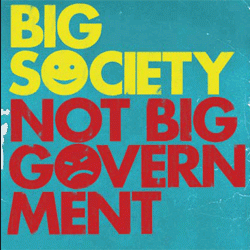
The time has come for policy-making to be based on evidence rather than belief.
Recent stories about the corruption and incompetence of private sector contractors delivering public services raise important questions about key assumptions at the heart of political debate. For those who haven’t read enough about it already, I recommend Private Eye’s excellent series of investigations into companies delivering the DWP’s contested workfare programme. Polly Toynbee also asks some valid questions in the Guardian here.
I cannot help but view these stories in their broader context, against a backdrop of systemic change in the philosophy of public service delivery, i.e. the idea of opening up all delivery to any able provider. Here’s how the Cabinet Office’s March 2012 Open Service review frames the current debate:
“This means replacing top-down monopolies with open networks in which diverse and innovative providers compete to provide the best and most efficient services for the public. It means re-thinking the role of government – so that governments at all levels become increasingly funders, regulators and commissioners, whose task it is to secure quality and guarantee fair access for all, instead of attempting to run the public services from a desk in Whitehall, city hall or county hall.”
As always, the use of language tells us a lot about underlying ideological assumptions. What we have here is a typical story of decline (public services not up to scratch), with a cause and a perpetrator (out-of-touch central or local administration sucking the life out of public services from their bureaucratic towers) as well as an agent capable of taking the reins and reversing the decline (the diverse and innovative providers).
story of decline >> cause selection >> agent >> control
This simple narrative structure (story of decline >> cause selection >> agent >> control) underpins pretty much all political activity. It’s incredibly useful, as it creates a remit for action, with the promoters of the narrative as the agents. Its imagery juxtaposes vibrant (private) service providers to grey out-of-touch (public) bureaucrats – needless to say that in our collective imagination, vibrant and colourful beats stale and grey quite effortlessly.
This is an old mantra – the idea that the private sector is by its very nature an innovative and efficient service provider, as opposed to the state, which isn’t. Four legs good, two legs bad, in other words. Political language reinforces this mantra though stories of decline and control such as the one above. It has become so established that it’s taken as a given, in political as well as public debate.
But scandals such as G4S, A4E and Working Links show that analysis and reflection have not yet become redundant. The time has come for policy-making to be evidence rather than belief-based. I am fully aware of my own outsourcing-sceptic bias when I say this. What this debate needs is a body of research looking at quality of service and public accountability and inquiring whether the private sector, with its profit imperatives and commercial focus, is indeed inherently and demonstrably better endowed to deliver high-quality public goods and services. Then and only then will public policy be informed by evidence, as opposed to belief, ideology and other superstitions – my own included.
When that happens, we can all accept, as the case may be, the self-evidently superior nature of the delivery of public services by the private sector as the only available option and only feasible way, as the Open Service review would have us believe.
“Given the fiscal constraints, the only feasible way of making the gains in quality of service that our economy and society so urgently need is to make a step change in the productivity of the public services. And the only feasible way of achieving such a step change in public service productivity is to introduce competition, choice and accountability – so that the public services can display the same innovation and entrepreneurial drive that characterise the best of the UK’s economy and society.”
Until then, I will keep wondering.
 Amplified
Pingback: There is no alternative | Amplified